
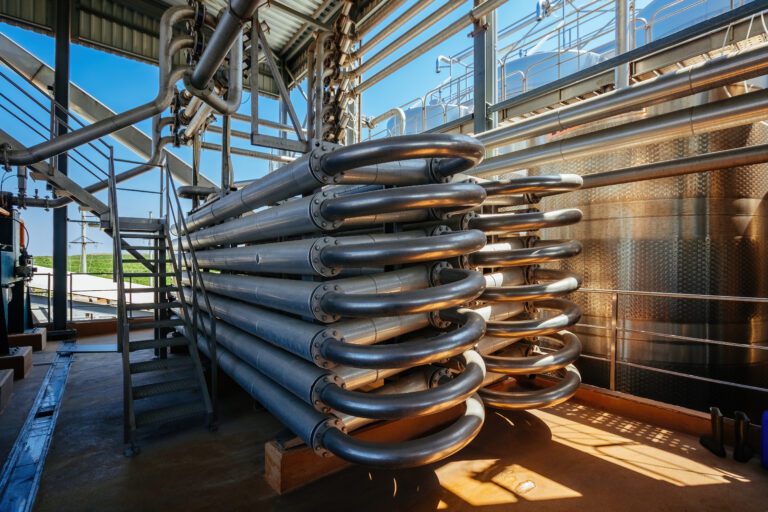
When a massive industrial heat exchanger fails, the fallout is rarely contained to a single broken component. In environments ranging from power generation plants and chemical refineries to large-scale HVAC systems, heat exchangers are the critical thermal engines that keep operations running. A failure can lead to catastrophic explosions, severe environmental hazards, and multi-million-dollar business interruption claims.
For litigation attorneys and insurance adjusters, handling a high-stakes claim involving thermal systems requires more than just an adjuster’s keen eye. It requires a comprehensive heat exchanger failure analysis to determine not just what broke, but exactly why it broke, who is responsible, and how to prove it unequivocally in a courtroom or arbitration setting.
Need immediate assistance with a complex industrial loss? If you are dealing with a catastrophic equipment breakdown or a multi-million dollar subrogation claim, time is of the essence. Contact Clarksean and Associates today for a free initial consultation and let our forensic engineering experts uncover the true root cause of your heat exchanger failure.
Understanding the mechanics behind these failures is the first step in building a bulletproof case. Below, we explore the most common causes of industrial heat exchanger failures and, more importantly, how a qualified forensic engineering expert proves them.
The High Stakes of Heat Exchanger Failures
Heat exchangers are designed to transfer heat between two or more fluids (liquids or gases) without mixing them. Because they operate under extreme pressures, massive temperature differentials, and often corrosive environments, the physical demands placed on their materials are immense.
When a failure occurs—whether it is a ruptured tube in a shell-and-tube exchanger, a blown gasket in a plate heat exchanger, or a catastrophic pressure vessel breach—the resulting litigation is often incredibly complex. Was it a latent manufacturing defect? Did the operator push the system beyond its thermal limits? Did poor maintenance lead to severe fouling and subsequent overheating?
Answering these questions requires an expert who can seamlessly blend mechanical engineering, fluid dynamics, and thermodynamics. At Clarksean and Associates, we rely on a systematic, data-driven approach to eliminate alternative hypotheses and pinpoint the single true root cause of the loss.
5 Common Causes of Industrial Heat Exchanger Failures
While every industrial accident is unique, the vast majority of heat exchanger failures can be traced back to one of the following five primary mechanisms.
1. Thermal Fatigue and Transient Stress
Heat exchangers are constantly subjected to temperature fluctuations. When a system is turned on and off, or when operational loads change rapidly, the metal components expand and contract. Over time, these repeated thermal cycles may create microscopic cracks in the material, particularly at stress concentration points like tube-to-tubesheet joints or welded seams.
This is known as thermal fatigue. In many litigation cases, the dispute centers on whether the fatigue was caused by a fundamental design flaw (e.g., failure to account for normal transient stress) or operator error (e.g., ramping up temperatures too quickly and shocking the system).
2. Flow-Induced Vibration (FIV)
Fluids moving at high velocities through a heat exchanger can create severe mechanical vibrations. If the frequency of these flow-induced vibrations aligns with the natural frequency of the internal tubes, the resulting resonance can cause the tubes to violently rattle against their support baffles or against one another.
FIV often leads to rapid mechanical wear, thinning of the tube walls, and eventual rupture. Investigating this requires a deep understanding of fluid mechanics to determine if the system was operating outside its designed flow parameters or if the internal baffle spacing was improperly engineered from the start.
3. Corrosion and Material Degradation
Because heat exchangers handle everything from cooling water to highly reactive chemicals, they are highly susceptible to corrosion. Common types include:
- Pitting Corrosion: Localized attacks that create deep holes in the metal.
- Stress Corrosion Cracking (SCC): A deadly combination of tensile stress and a corrosive environment that leads to sudden, brittle failure.
- Galvanic Corrosion: Caused when two dissimilar metals are in contact within an electrolyte (like untreated water).
In a forensic investigation, determining the exact type of corrosion is critical. It answers whether the failure was a maintenance issue (e.g., poor water chemistry management) or a specification error (e.g., the manufacturer used the wrong grade of stainless steel for the intended chemical environment).
4. Fouling and Blockage
Fouling occurs when unwanted materials—such as scale, algae, silt, or chemical byproducts—accumulate on the heat transfer surfaces. While fouling is generally considered a maintenance and efficiency issue, severe fouling can lead directly to catastrophic mechanical failure.
When a thick layer of scale coats a tube, it acts as an insulator. To maintain the necessary heat transfer, operators might increase the temperature of the heating fluid. This causes the metal beneath the fouling layer to overheat, lose its structural yield strength, and ultimately burst under pressure.
5. Manufacturing or Design Defects
Sometimes, a heat exchanger is doomed before it ever reaches the industrial plant. Manufacturing defects can include improper welding techniques that leave weak joints, or inadequate tube expansion (where the tubes are not properly sealed into the tubesheet, allowing fluids to mix).
Design defects are equally problematic. If an engineer fails to properly calculate the thermal loads, specifies the wrong materials, or designs a system with inadequate flow distribution, the heat exchanger will inevitably fail under normal operating conditions. Proving a design defect requires an expert who can essentially reverse-engineer the unit and audit the original mathematical calculations.
How to Prove the Root Cause in Court
Identifying the failure mechanism is only half the battle; proving it to a judge, jury, or opposing counsel is where a highly qualified forensic engineering expert becomes indispensable. Complex thermal dynamics cannot be explained with hand-waving; they require rigorous, science-backed evidence.
Here is how we prove the root cause in a heat exchanger failure analysis:
Advanced Computational Engineering Analysis
To understand what happened inside a sealed, high-pressure vessel at the moment of failure, we use advanced computational tools to recreate the environment virtually.
- Computational Heat Transfer (CHT) and Computational Fluid Dynamics (CFD): We use CFD to simulate the exact airflow, liquid movement, and velocity inside the heat exchanger. CHT allows us to track temperature gradients and thermal performance. By inputting the system’s operating data at the time of the loss, we can visually demonstrate to a jury exactly where localized overheating or flow blockages occurred. Learn more about our Engineering Analysis capabilities here.
- Finite Element Analysis (FEA): To prove structural failures, we utilize FEA. This allows us to map the stress, strain, and deformation on specific components. If a header box blew off, FEA can show whether it failed due to an over-pressurization event (operator error) or because the metal was too thin to handle normal operating pressure (design defect).
Fault Tree Analysis and Elimination
In a courtroom, opposing experts will often try to muddy the waters by suggesting alternative causes for the failure. A robust failure analysis anticipates this. We utilize fault tree analysis to systematically map out every possible way a component could have failed. By applying engineering principles, operational data, and physical evidence, we systematically eliminate the incorrect hypotheses until only the true root cause remains. This methodology leaves little room for opposing counsel to introduce doubt.
Experimental Testing and Validation
Sometimes, the most effective way to prove a hypothesis is to physically recreate the failure in a controlled environment. Through experimental testing, we can take exemplar components—like a section of tubing or a welded joint—and subject them to the pressures, temperatures, or vibrational frequencies we believe caused the loss. When an expert can show a jury a physical piece of metal that failed in the exact same manner as the evidence from the scene, the testimony becomes highly compelling.
The Importance of a Proven Forensic Engineering Methodology
Industrial heat exchanger failures are never simple. They exist at the intersection of thermal dynamics, fluid mechanics, and material science. When millions of dollars in damages, insurance subrogation claims, or product liability lawsuits are on the line, you cannot afford to rely on superficial inspections.
You need an expert who understands not only how to find the answer but how to present complex data—like von Mises stress levels or transient thermal gradients—in a clear, defensible, and accessible way. Dr. Randy Clarksean has spent over 30 years applying rigorous engineering fundamentals to complex problems, providing clients with the insights they need to resolve disputes and win cases.
Are you handling a complex litigation case involving an industrial mechanical failure? Our team is ready to review your technical documentation and provide a clear, science-backed path forward. Contact Clarksean and Associates today to schedule your free initial consultation. We will prepare a detailed proposal outlining the specific tasks and engineering analysis needed to uncover the truth.
