
More and more of the devices we use every day rely on batteries. These devices often streamline or simplify our lives: an immersion blender, a Bluetooth speaker, an electric vehicle, power tools. You name it, and there is most likely a battery-operated version of it.
With so many of these devices in homes and businesses, a battery-powered device is often found near the origin of a fire. But being present is not the same as being the cause. Here is how a lithium-ion battery fire investigation works under NFPA 921, from the area of origin through the root cause of the battery failure.
| Key Takeaways Every fire investigation starts with the area of origin. Without it, the number of battery devices in the structure doesn’t matter.NFPA 921 and the scientific method guide the investigation, just as in any other fire.Every potential ignition source in the area of origin must be evaluated on equal footing, not just the battery.A battery can be the cause of a fire or a victim of it. When the evidence can’t tell the two apart, the cause is undetermined.If a battery did cause the fire, a root cause analysis can show why it failed: mechanical, electrical, or thermal abuse. |
Step 1: Determine the Area of Origin
The start of any fire investigation is determining the origin of the fire, if at all possible. If you cannot determine the area of origin, it will not matter how many cordless (battery-operated) devices were in the structure.
NFPA 921 is, of course, the guide to fire investigations. Chapter 4 of NFPA 921 (2024 edition) outlines the basic methodology for conducting a fire investigation, and Section 9.15 specifically addresses batteries. I would anticipate that this section will continue to grow as NFPA 921 is revised and updated.
Follow the Scientific Method
As always, the scientific method is the approach to take. The figure below shows that process: data collection, data analysis, hypothesis development, and then testing each hypothesis to ensure it is supported by the available data. Science and data are the keys. (For a deeper look at this process, see how a forensic fire investigator determines the cause of a fire.)

The scientific method, as applied in fire investigations under NFPA 921.
Use Fire Patterns to Locate the Origin
Determining the area of origin of a battery fire, say in a structure, is the same as it has always been. Chapter 6 of NFPA 921 discusses fire effects and fire patterns at length, explaining how to analyze the data at the scene to help determine the origin.
Step 2: Identify Every Potential Ignition Source
Once the area of origin has been determined, it is time to work on the cause of the fire within that origin. Every fire needs three things: fuel, oxygen (air), and a source of ignition (heat). That remains true for a fire that may have been caused by a lithium-ion battery.
While examining the area of origin, the investigator needs to assess everything in that area that could have caused the fire. Sure, there was a battery-operated device in that space, but what about other potential ignition sources, such as:
- Kitchen appliances
- Hair dryers
- Lamps and other light fixtures
- Any other electrical appliances within the area of origin
If they are within the area of origin, they should be evaluated.
Don’t Let Bias Cut the Investigation Short
Don’t allow a bias toward the battery to stop you from doing a thorough job. Either make a well-supported case on site that day, or collect the other potential ignition sources for a future evidence examination with all interested parties.
Multiple Battery Devices: Cause of the Fire or Victim of It?
What should you do if there are multiple battery-powered devices within the area of origin? Again, each needs to be evaluated on equal footing with every other potential fire source.
But with lithium-ion batteries, there is a “chicken and egg” scenario: the investigator has to determine whether a battery pack was damaged as a result of the fire, or was the cause of the fire. That can be difficult. If the devices were close to each other, both could be totally destroyed.
How Thermal Runaway Spreads Between Devices
A fire in one device can generate enough heat to overheat the batteries in an adjacent device. That leads to thermal runaway, a self-sustaining reaction in which a battery cell keeps heating itself, and to the destruction of the second device. The end result can look the same for the device that started the fire and the device that was caught in it.
When the Cause Is Undetermined
What happens then? You have two devices, either of which could have caused the fire, but the damage to the battery packs is so severe that you cannot clearly determine which one started it. At that point, the cause would be classified as undetermined, unless there is more data to collect and analyze.
One key piece of evidence, with the advent of low-cost surveillance systems, might be video footage stored off site.
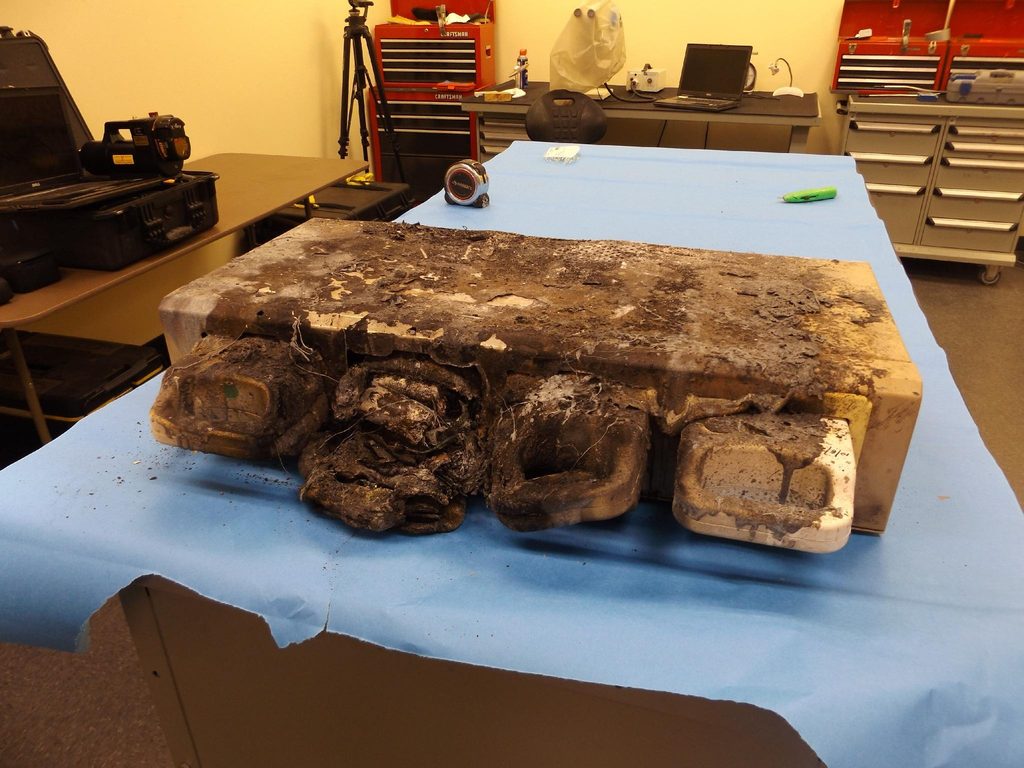
Damaged lithium-ion battery packs during an evidence examination.
| Investigating a Battery Fire Claim or Lawsuit? Dr. Randy Clarksean, Ph.D., P.E., CFEI, investigates fire origin and cause, including lithium-ion battery fires, for insurers, attorneys, and manufacturers. Every conclusion follows NFPA 921 and is supported by the evidence.Call (218) 371-1967 or request a case review today. |
Step 3: Find the Root Cause of the Battery Failure
If the origin and cause investigation determines that a lithium-ion battery caused the fire, more investigation may be needed to find out exactly why the fire started in the battery pack. This is where a root cause analysis and failure analysis come in.
The figure below outlines the three common types of lithium-ion battery failure: mechanical abuse, electrical abuse, and thermal abuse. Each can stem from the design, from manufacturing, or from a failure to warn the user.
Mechanical Abuse
Examples include a lack of protection from impact, a potential for puncture, poor placement of the battery system, wrong parts or materials, poor assembly, and a user who modifies the system or uses it improperly.
Electrical Abuse
Examples include poor battery management system (BMS) specifications that allow rapid charging or discharging, a poor charger design, the wrong battery pack, substandard batteries from the supply chain, and use past the expected design life.
Thermal Abuse
Examples include poor cooling system design, poor temperature measurement, no thermal runaway detection where it is needed, supply chain issues with fans or materials, and use in environments that are too hot or too cold.
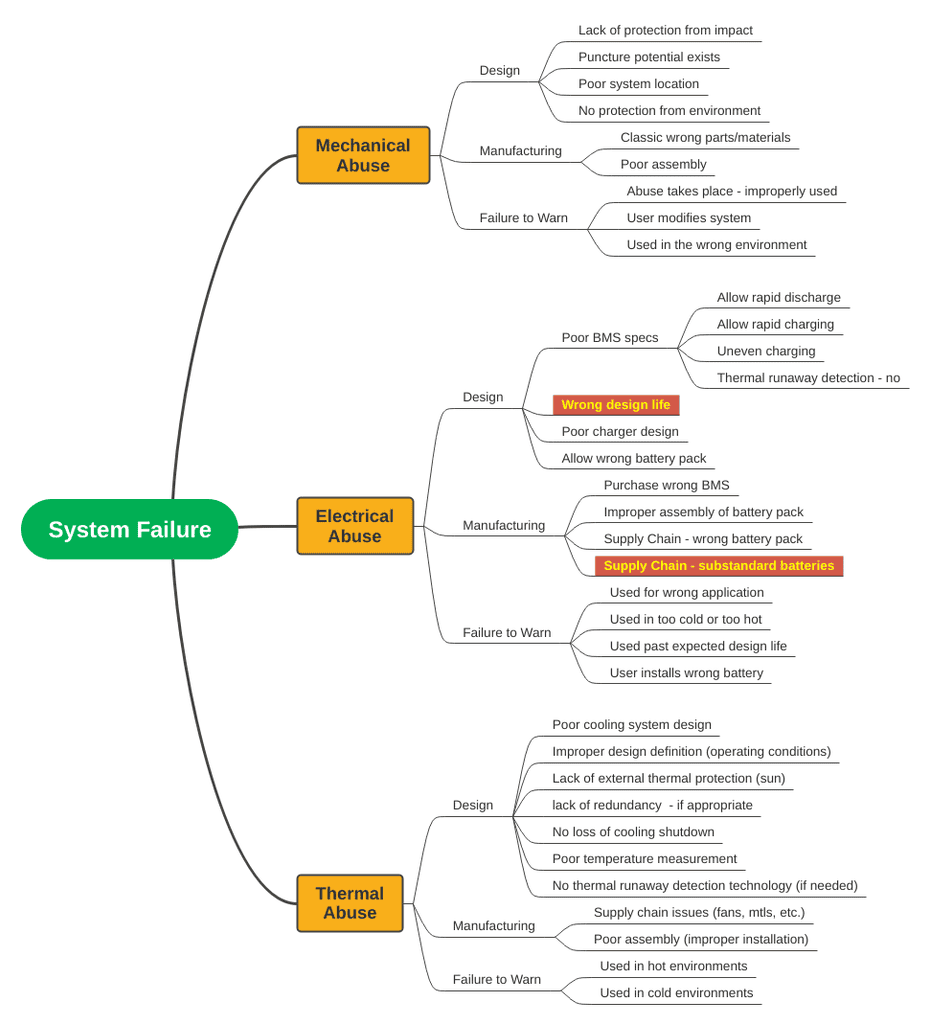
Common causes of lithium-ion battery failure. This is by no means a complete list.
These root causes are often at the center of product liability investigations, where the question becomes whether a design defect, a manufacturing defect, or a failure to warn led to the fire.
Why Lithium-Ion Battery Fires Call for an Experienced Investigator
Fire investigations can be very complicated. Batteries as the cause of a fire are not new, but they can add complexity to the investigation. Finding the true root cause for a client, commercial or legal, can be an involved process that has to consider any number of design or manufacturing issues.
| Need a Lithium-Ion Battery Fire Investigation Expert? Clarksean & Associates provides fire origin and cause investigations, battery failure analysis, and expert witness testimony, backed by more than 30 years of engineering experience.Call (218) 371-1967 or request a case review today. |
Frequently Asked Questions About Lithium-Ion Battery Fires
What is the first step in a lithium-ion battery fire investigation?
Determining the area of origin. Until the origin is established using fire patterns and the methodology in NFPA 921, the investigator can’t say whether a battery device was involved in starting the fire.
Can an investigator tell if a battery caused the fire or was damaged by it?
Often, yes, but not always. A fire in one device can push nearby batteries into thermal runaway. If multiple devices are destroyed and the evidence can’t separate cause from victim, the cause is classified as undetermined unless more data, such as video footage, is available.
What causes lithium-ion batteries to catch fire?
Most failures fall into three categories: mechanical abuse (impact or puncture), electrical abuse (for example, improper charging or a poor battery management system), and thermal abuse (overheating or poor cooling). Each can trace back to design, manufacturing, or a failure to warn.
Does NFPA 921 cover battery fires?
Yes. NFPA 921 (2024 edition) addresses batteries in Section 9.15, and the guide’s general methodology in Chapter 4 and fire pattern analysis in Chapter 6 apply to battery fires just as they do to any other fire.
