
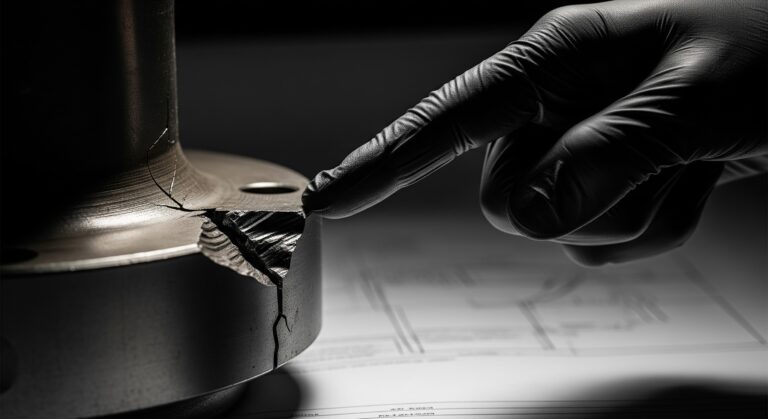
In the high-stakes arena of complex litigation, the difference between winning and losing often comes down to a single, profound question: Why? When a multi-million dollar piece of industrial equipment collapses, a hospital backup battery system catches fire, or a consumer product causes a severe personal injury, the fact that a failure occurred is rarely in dispute. The broken pieces are right there for everyone to see. However, proving exactly why those pieces broke—and who is ultimately responsible—requires far more than just pointing at the wreckage. It requires the meticulous, science-backed investigation of a Failure Analysis Expert Witness.
For attorneys, insurance adjusters, and corporate counsel, navigating the technical complexities of a catastrophic loss can be daunting. You are dealing with specialized engineering systems, conflicting expert opinions, and the heavy burden of explaining intricate physics to a judge or jury. This is where an independent, highly credentialed engineering expert becomes the most valuable asset in your legal strategy.
Need an independent expert to review the technical facts of your case? > Finding the true root cause of a complex failure requires decades of engineering experience. Contact Clarksean and Associates or email Dr. Randy Clarksean directly at randy.clarksean@gmail.com to start the review process today.
What is a Failure Analysis Expert Witness?
A failure analysis expert witness is a highly trained professional—typically a licensed Professional Engineer (P.E.) with an advanced degree—who applies the principles of science, mathematics, and engineering to investigate why a system, component, or process failed.
Their role extends far beyond standard engineering. As a Forensic Engineering Expert, they are specifically trained to conduct investigations with litigation in mind. This means their methodology must be rigorous, their documentation must be impeccable, and their conclusions must be legally defensible. They understand that every note taken, every photograph captured, and every calculation performed could eventually become part of a civil lawsuit file and be subject to intense cross-examination.
The ultimate goal of the expert witness is not just to discover the truth, but to translate that truth into clear, objective, and compelling testimony that a non-technical audience can easily understand.
The Crucial Difference Between “What Happened” and “Why It Happened”
At the very start of a legal investigation, the initial facts might seem straightforward. You might know, for example, that a structural bolt failed, leading to the collapse of a solar energy support structure.
A surface-level review might conclude that the bolt failed due to metal fatigue. To an untrained eye, the case might seem closed. But a true Failure Analysis goes much deeper. Saying a bolt failed due to fatigue is merely identifying the mechanism of failure; it does not identify the true root cause.
To determine liability, a failure analysis expert witness must ask a cascade of critical questions:
- What caused the fatigue in the first place?
- Were the structural loads those originally used in the design, or was the system overloaded?
- Were the initial design calculations simply in error?
- Was the wrong size or type of bolt installed during manufacturing?
- Was the bolt torqued properly by the installation crew?
- Did the bolt exhibit unexpected signs of chemical corrosion?
- Is the chemical makeup of the bolt actually what the supplier claimed it was?
If the investigation reveals that a Grade 5 bolt was used instead of the specified Grade 8 bolt, the focus of the litigation shifts entirely from a design defect to a manufacturing or supply chain error. Eliminating all other potential failure scenarios is vital because it provides absolute confidence in the final conclusion. When dealing with a $35 million mining equipment collapse or a $20 million loss in a solar thermal storage tank, you cannot afford guesswork. You need undeniable proof.
The Scientific Toolkit of a Failure Analysis Expert
To uncover the true root cause and provide unshakeable testimony, a failure analysis expert witness utilizes a comprehensive toolkit of advanced engineering methodologies.
1. Fault Tree Analysis
One of the most effective ways to ensure no potential failure mechanism is overlooked is the development of a fault tree. This logical, top-down diagram allows the engineer to map out every conceivable path that could have led to the failure. By systematically ruling out branches of the tree using physical evidence and data, the expert narrows down the possibilities until only the true root cause remains.
2. Meticulous Engineering Analysis
Often, physical evidence alone isn’t enough to prove a case. The expert must recreate the conditions of the failure using mathematical and physics-based models. Through rigorous Engineering Analysis, an expert can determine exactly how much stress a component was under, or how hot a system became before it caught fire.
- Hand Calculations: Sometimes, simple but elegant analytical solutions calculated in a spreadsheet are more than adequate to prove a design flaw.
- Finite Element Analysis (FEA): For complex structural issues, FEA is used to model the stress and strain on a component, revealing exactly where a material yielded or fractured.
- Computational Fluid Dynamics (CFD): If the failure involved complex fluid flows or heat transfer—such as a boiler explosion or a heat exchanger rupture—CFD helps visualize and calculate the invisible forces at play.
3. Natural Frequency and Vibration Analysis
Many mechanical failures are the direct result of uncontrolled vibrations. If a component is installed in an environment where it is subjected to forces matching its natural frequency, it can rapidly vibrate itself to destruction. A skilled expert can conduct a Natural Frequency Analysis to prove whether a design adequately accounted for environmental vibrations, such as wind shedding over a solar panel array.
4. Experimental Testing
When calculations need physical validation, or when opposing counsel questions a specific theory, Experimental Testing is heavily utilized. By creating controlled experiments—whether it’s testing the tensile strength of an exemplar part, or validating the ignition temperature of a chemical compound—the expert can physically demonstrate the failure mechanism to the court.
Key Areas of Litigation Requiring Failure Analysis
A failure analysis expert witness is an indispensable partner across several major areas of law and insurance.
Product Liability Investigations
When a product fails and causes injury or property damage, manufacturers, distributors, and retailers can all be pulled into the fray. Product Liability Investigations generally center around three types of defects:
- Design Defects: The product was manufactured perfectly, but an inherent flaw in the engineering makes it dangerous (e.g., specifying the wrong material for a load-bearing joint).
- Manufacturing Defects: The design was safe, but an error on the assembly line or a substituted material made the specific unit dangerous.
- Failure to Warn: The product functions as designed, but the manufacturer failed to provide adequate instructions or warnings about foreseeable hazards.
An engineering expert uses hard data to pinpoint exactly where in the product’s lifecycle the fatal error occurred, ensuring liability is placed accurately.
Insurance Subrogation and Major Losses
Insurance companies routinely handle multi-million dollar claims for property damage caused by fires, pipe bursts, and structural collapses. To successfully subrogate a claim and recover costs from the responsible party, the insurer must definitively prove negligence or product failure. Whether investigating an explosion in a residential structure or a multi-million dollar turbine blade failure in a power plant, the failure analysis expert provides the technical foundation required to recover those massive losses.
Patent Infringement and Intellectual Property
Not all failures are physical explosions; sometimes, the failure is a breach of intellectual property. In patent infringement cases, an expert witness is often needed to reverse-engineer a product or system to determine if it infringes on the technical claims of an existing patent. By analyzing the engineering mechanics and comparing them against patent documentation, the expert provides clarity in highly convoluted IP disputes.
The Value of Clear, Defensible Testimony
The ultimate test of a failure analysis expert witness occurs in the deposition room or on the witness stand. The most brilliant engineering analysis in the world is useless if it cannot be communicated effectively to a judge and jury.
Opposing counsel will inevitably attempt to find flaws in the methodology, question the assumptions made in the computer models, or introduce competing theories. A seasoned expert, like those at Clarksean and Associates, anticipates these challenges from day one. By ensuring their work is independent, strictly based on the physical facts, and verified through redundant analysis methods, they immunize their testimony against aggressive cross-examination.
Furthermore, an elite expert knows how to teach. They strip away the impenetrable engineering jargon, using analogies, clear visual aids, and straightforward language to ensure the jury fully grasps the why behind the failure.
Securing Your Legal Strategy with the Right Expert
Complex litigation demands precision, objectivity, and undeniable technical authority. Whether you are dealing with an industrial fire, a catastrophic structural collapse, or a highly contested product liability claim, bringing a failure analysis expert witness onto your team early can shape your entire legal strategy. They help you uncover the truth, rule out false theories, and build a narrative grounded in the unyielding laws of physics.
Don’t leave the technical facts of your case open to interpretation.
Dr. Randy Clarksean (Ph.D., P.E., CFEI) has over 35 years of experience investigating complex mechanical, thermal, and structural failures globally. Provide your legal team with clear, defensible, science-backed answers. Contact Clarksean and Associates today to discuss your litigation support needs.
